I’m concerned because I chipped a lower incisor almost a year ago, and the bonding won’t stay on it. My dentist has re-bonded the tooth three times, most recently in April, and the bonding is loosening again. Are there special materials my dentist should use to keep the bonding on? Thanks. Ravi from IL
Ravi,
Chipped lower incisors are challenging to restore because they are involved in biting every time the mouth closes. The edges of these teeth contact the inner surfaces of the upper front teeth repeatedly throughout the day.
That constant contact can place considerable stress on any restoration attached to the edge of the tooth. For this reason, repairing the chip requires careful attention to the restoration and the patient’s bite.
Why Might Dental Bonding Loosen?
Several conditions can increase the risk of bonding failure:
A thorough bite evaluation is essential because replacing the bonding alone may not solve the underlying problem.
- Premature contact with the upper teeth
- Uneven distribution of biting forces
- Tooth positioning that places one tooth under greater stress
- Repeated impact on the repaired edge
At times, how upper and lower teeth meet can affect treatment options and the stability of dental bonding. In the example shown, both lower central incisors appear to have received composite repairs. One restoration remained in place, while the other failed. A close examination suggests that one tooth extends slightly farther forward than its neighboring tooth. If that tooth contacts the upper teeth first, it will absorb more force than the surrounding teeth.
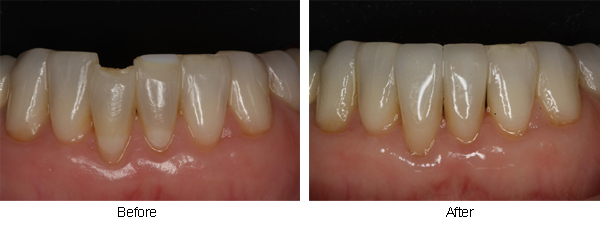
Chipped lower incisor photos courtesy of Dr. Ian Bell of Bellevue, WA
How Was the Problem Successfully Treated?
In this case, porcelain veneers were used to restore the affected teeth. The tooth that projected farther forward was reshaped so it aligned more closely with the adjacent incisor.
When all lower incisors contacted the upper teeth more evenly, the stress on the restorations decreased significantly. This type of correction often improves the longevity of the treatment.
An experienced cosmetic dentist may also achieve a similar result with carefully planned composite bonding.
What Is an Alternative to Dental Bonding?
When advanced cosmetic treatment is not readily available, smoothing and rounding the chipped edge may be the most practical solution. This conservative approach can reduce irritation and improve comfort without requiring extensive treatment.
A dentist can assess the bite, explain the available options, and help determine the most appropriate course of action based on the patient’s circumstances.
Dr. Steven Brooksher, a Baton Rouge accredited cosmetic dentist, sponsors this post. Read why so many patients say Dr. Brooksher is the best dentists in Baton Rouge.