Dr. Steven Brooksher, DDS
Address: 1010 South Acadian Thruway, Ste. A, Baton Rouge, LA 70806
  • Home
  • About Us
    • Meet Dr. Brooksher
    • Meet Our Team
    • Your First Visit
    • Contact Us
    • What Makes Us Different?
    • Patient Forms
    • Financial Policies
    • Pay Online
    • Request an Appointment
  • Cosmetic Dentistry
    • Cosmetic Dentistry
    • Smile Gallery
    • Porcelain Veneers
    • Dental Bonding
    • Teeth Whitening
    • Smile Makeover
    • SmileFy Smile Design
    • Porcelain Crowns
Call us: (225) 346-8625
  • Tooth Replacement
    • Dental Implants
    • Dental Implant Hybrids
    • Implant Overdentures
    • Dentures
  • Sedation
  • Other
    • Emergency Dentist
    • Metal-Free Dentist
    • Porcelain Crowns
    • TMJ Treatment
Life-changing dentistry

Complete dental care, from checkups and cleanings to complex restorative dentistry and life-changing smile makeovers.

Request an
Appointment

How many times can I get a root canal on the same tooth?

Posted on October 31, 2020 by AllSmiles.

Six years ago, my dentist did a root canal on a top right molar. The tooth is hurting again, and I am worried that I will need a dental implant. Is it possible to save a tooth that already had a root canal? Can a tooth remain stable after a second root canal? Thanks. Rachel

Rachel,

A dentist can repeat root canal treatment on a tooth two or more times. But successive root canal treatments don’t always make sense.

Can Root Canal Treatment Be Repeated?

Although a dentist can do a second or third root canal treatment—or more—on a tooth, the results are unpredictable. Even the most skilled dentists can perform root canal treatment that fails.

Studies show that root canal treatment has an 86 – 98% success rate. But cleaning out the canals of a tooth can be tricky. If a dentist doesn’t thoroughly remove infected tooth pulp, the infection will be sealed in the tooth only to flare up later.

A molar tooth has three canals, but sometimes a tooth has a “hidden” fourth canal. Sometimes a canal will branch out at a right angle. And although a dentist uses tiny, flexible instruments, it can be difficult—if not impossible—to get the device into angled canals to remove the infection.

Although highly angled canals are rare, when they exist, the probability of needing a repeat root canal increases. Retreatment has a 50 – 75% success rate. And if a highly skilled dentist performed the first root canal treatment, a second one might not work.

What About Root Canal Surgery?
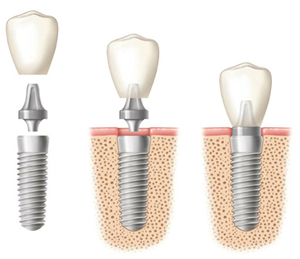
Diagram of the phases of a dental implant for a comparison to a partial denture.

Get a root canal second opinion before agreeing to an extraction and dental implant

Root canal surgery is also known as an apicoectomy. During the procedure, a dentist makes an opening in the bone, cuts off the infected root tip, and fills the end of the tooth. But if tooth roots are not readily accessible, the surgery is risky and can damage the lower jaw and lip nerve.

An extraction and dental implant are the last options. If you’re uncomfortable with your dentist’s skill level, you can seek a second opinion with a dentist who is skilled in root canal treatment. Or you can ask your dentist to refer you to an endodontist, a root canal specialist. If you’re anxious about future procedures, ask your dentist or endodontist about sedation options.


Dr. Steven Brooksher of Baton Rouge sponsors this post. Dr. Brooksher has advanced training in restorative dentistry.
Filed Under: Dental Implants Tagged With: apicoectomy, how many times can a root canal be repeated, root canal extraction, root canal failure, root canal success rate, root canal surger

My dental implants failed in five days

Posted on October 26, 2020 by AllSmiles.

In September, I received four dental implants for $1850 each. I was supposed to receive three more implants. But I have stopped the process because two of the five implants came out the five days after surgery. Should I be charged for two implants that failed? Is this a common occurrence or do I have good reason to distrust my dentist? Thank you. Sheldon from GA


Sheldon,

Authority Dental estimates that dental implants have a 5% failure rate. And most failures occur over months or years—not days. Half of your dental implants failed. You should not have to pay your dental for failed implants.

Why Do Dental Implants Fail?

Dental implants fail due to infection, shortcuts, cheap implant fixtures, premature restoration, and sometimes health reasons.

  • Infection – Poor-fitting implant fixtures allows bacteria to grow around the implants and cause an infection.
  • Diagnostic shortcuts – Successful dental implants require 3-D CT scans to reveal your bone structure and surrounding areas. The scans show if you need bone grafting and where to place your implants for the best results.
  • Cheap implant fixtures – Low-quality dental implants don’t last. And they can cause infection.
  • Incorrect implant placement – Implants placed in the wrong location can loosen and fail.
  • Premature restoration – If a dentist places dental crowns or dentures on implants before the implants fuse with the jawbone, they will fail.
  • Smoking – Smoking restricts your blood flow and inhibits the healing process. Healing time will be slower, or dental implants might have.
  • Medical condition – If you have uncontrolled diabetes or a medical condition that decreases your ability to heal, it can affect the success of your dental implants.

What to Do When Your Dental Implants Fail

Diagram of the phases of a dental implant for a comparison to a partial denture.

When your dentist plans carefully, a dental implant fuses with the bone and anchors a crown

When dental implants fail, it’s wise to get a second opinion. Look for a specialist or a dentist with a fellowship in a dental implant organization like the International Congress of Oral Implantologists or the American Academy of Implant Dentistry. If two of your four implants failed on the fifth day, you’re at risk of losing the remaining implants.

Ask your current dentist for your dental records and x-rays before scheduling an appointment with an implant specialist. Although your current dentist should willingly refund you for failed dental implants, other steps you can take include:

  • Ask your new dentist to communicate with your former dentist in requesting a refund.\
  • Report your current dentist to the state dental board
  • Hire a malpractice attorney


We hope that your dentist will promptly refund you without resistance. Best wishes on your dental implant recovery. We hope you can soon smile with relief.


In Baton Rouge, you can get a dental implant second opinion from Steven Brooksher, DDS. Dr. Brooksher is a Fellow of the International Congress of Oral Implantologists.

Filed Under: Dental Implants Tagged With: cheap dental implants, dental implant CT scan, dental implant failure, dental implant fixture, dental implant second opinion, dental implant shortcuts, dental implant xray, dental implants, dental implants diabetes, dental implants smoking, what causes dental implant failure

Is It Too Late for Dental Implants?

Posted on October 14, 2020 by AllSmiles.

After wearing dentures for 18 years, is it too late for dental implants? My dentures won’t stay in, and my entire experience with wearing them has been disappointing and frustrating. It’s almost time for new dentures, and if I can minimize my misery, I would love it. Thanks. Vera from Biloxi, MS


Vera,

No, it’s not too late for dental implants. There isn’t a limit on how many years you can wear dentures before you’re not a candidate for implants, but you’ll need to be patient with the process. We’ll explain.

Dentures and Jawbone Resorption

The longer you wear complete removable dentures, the more your jawbone will shrink. Jawbone shrinkage occurs in areas where teeth are missing. And when all your teeth are missing, the entire surface of your jawbone shrinks. Your body takes the minerals from the bone and uses them elsewhere. As your jawbone shrinks, it’s more difficult for your denture to stay in place.

Dental Implants and Bone Volume

An implant dentist or oral surgeon places implants in your jawbone with the goal of the bone and implant fusing to anchor a denture or arch of teeth. If you have significant bone loss, your jawbone won’t support implants.

If You Don’t Have Enough Bone for Dental Implants

If you don’t have enough jawbone to support dental implants, implant dentists offer two treatment options—bone grafting and All-on-4 dental implants.

Bone grafting for dental implants

Bone grafting for dental implants is a procedure that takes bone from one part of your body, like your hip, to use it for building up your jawbone. As an alternative, a dentist might use sterilized or artificial bone. Depending on the type of bone used and the extent of bone loss, the Academy of Osseointegration says it can take four to twelve months for grafts to heal. After healing, you can receive dental implants. Your implant dentist will explain your options for grafting.

All-on-4 dental implants

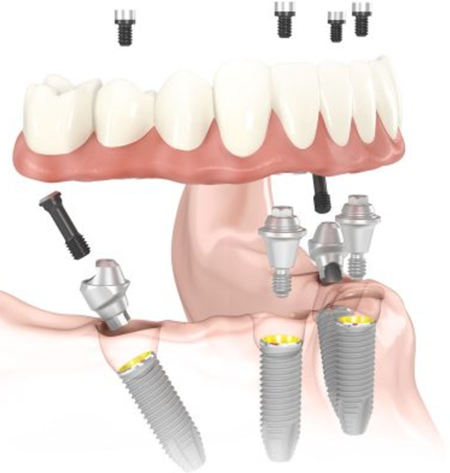
Denture above dental implants ready to be screwed on

Dental implants secure dentures

All-on-4 dental implants are a system that angles implants in the front of your mouth. The bone in the front of your mouth is often thicker than other areas. And angling the implants increases contact with the bone and resistance to movement. Implant dentists use 3-D cone beam computed tomography (CBCT) scans to see your bone structure and identify a precise location for All-on-4 or All-on-6 dental implants. This process prevents the need for bone grafting. But your implant dentist will determine if you’re a candidate for this treatment.

For predictable results, look for an implant dentist who is a Fellow of the International Congress of Oral Implantologists. Dentists with fellowship have advanced dental implant training and experience and have completed rigorous testing and examination of their patient cases by a review board.

You can receive implant-supported dentures and have a comfortable, confident smile at last.


Steven Brooksher, DDS, a Baton Rouge dentist, sponsors this post. Dr. Brooksher is an accredited cosmetic dentist and a Fellow of the International Congress of Oral Implantology. He completes implant surgery and restores implants with dental crowns or dentures.

Filed Under: Dental Implants Tagged With: all on 4 implants, dental implants, dental implants bone graft, dental implants for dentures, dentures, how long for healing bone graft implant, human or cow bone graft, implant overdenture, is it too late for dental implants

Shouldn’t a sinus perforation have healed by now?

Posted on September 27, 2020 by AllSmiles.

In June, my dentist extracted two teeth, and I’m waiting to get dental implants. For one upper right tooth, my dentist said he could see into my sinuses. He prescribed antibiotics for me to take for a week. I didn’t have any special instructions other than taking antibiotics. My other tooth healed fine, but the sinus perforations still isn’t closed. My primary care doctor prescribed more antibiotics. I have a continual headache and a low-grade fever. How long does it take for a sinus perforation to heal? It’s going to be months before I can get dental implants. I think I need a second opinion. Am I going to need an oral surgeon or an ENT doctor to close the perforation? Thanks. Clay

Clay,

It seems that your dentist doesn’t know how to handle a perforation that doesn’t heal. It’s wise to get a second opinion.

How Long Will Does It Take for a Sinus Perforation to Heal?

If your sinus is perforated from tooth extraction, the tissue normally heals within four to six weeks. Bone grafting is often needed, though, and it will heal in about six months. If a perforation from an extraction doesn’t heal, there are several possible causes. Two possibilities include:

  • A root tip from the tooth is pushed into the sinus
  • A bone fragment remains

Has your dentist or primary doctor sent you or an x-ray of your sinus? It’s best to visit an otolaryngologist (ear, nose, throat (ENT) specialist) who will request an x-ray, see I something if blocking the sinus, remove it, and ensure the infection goes way by prescribing more antibiotics.

If there is a bone fragment in your sinus, it’s good that your dentist didn’t close the perforation. The irritation from the fragment would cause ongoing infection and fluid drainage into your mouth and nose.

Closing a Sinus Perforation

Diagram of the phases of a dental implant for a comparison to a partial denture.

After sinus perforation and bone grafting heal, you can receive dental implants

How is a sinus perforation closed? Although your doctor might have a specific technique, the procedure includes steps like these.

  • Place collagen plugs or another resorbable membrane in the tooth socket
  • Gently place bone graft around the sides
  • Secure the bone graft and protect the site with another collagen plug or resorbable membrane
  • Stitch the membrane over the graft to keep it in place

After closing the perforation, a specialist will prescribe antibiotics, and based on the severity of your infection, tell you how long to take them. You’ll have follow-up appointments to ensure the area heals well.

Tell your ENT doctor about your plans for dental implants to replace your two missing teeth. The doctor and your implant dentist can discuss the optimal time for implant placement. Both the perforation and bone graft must heal before you receive dental implants. Otherwise, the implant and your jawbone won’t fuse, and the implants will fail. Be patient.


Steven Brooksher, DDS, a Baton Rouge dentist and Fellow of the International Congress of Oral Implantologists, sponsors this post.

Filed Under: Dental Implants Tagged With: collagen plug, collagen plug sinus perforation, dental implant bone graft, dental implant Fellow Baton Rouge, dental implant sinus perforation, ENT sinus perforation, how long for sinus bone graft to heal, how long for sinus perforation to heal, ICOL Baton Rouge, International Congress Oral Implantologists Baton Rouge, oral surgeon sinus perforation, sinus perforation, tooth extraction, tooth extraction dental implants, tooth extraction sinus

When steroids after root canal treatment don’t work

Posted on September 18, 2020 by AllSmiles.

In April, my dentist did a root canal on a molar tooth and put a crown on it. About two weeks after the procedure, the tooth started to hurt. My dentist did x-rays and said there are no cracks in the tooth, and it appears to be stable. My dentist referred me to an endodontist two months letter because the pain persisted. The endodontist prescribed antibiotics for two weeks. When I returned to the office, the endodontist examined my tooth and said it would continue to improve. I traveled to late July for an extended stay with my elderly parents, who needed my help with a personal issue, and my tooth was fine. After returning home last Tuesday, a severe toothache woke me up from sleep. The endodontist prescribed more steroids, but my tooth is still throbbing. Help! What is wrong with my tooth? Am I going to need an extraction? Jennifer from Laurel, MS

Jennifer,

Although steroids are a popular treatment for root canal pain, sometimes they don’t work. And in your case, it’s clear that your endodontist’s treatment isn’t working. A combination of poor diagnostic skills and a lack of understanding of pharmacology for your case—is prolonging your recovery.

Root Canal Treatment Pain and Steroids

We disagree prescribing steroids for your root canal treatment pain several reasons:

A steroid is an effective anti-inflammatory drug that calms the body’s response to inflammation. But inflammation has a purpose. The body’s response is to send white blood cells to fight infection. So steroids not only block inflammation, they block the body’s response to infection. A dentist must understand what’s happening inside a tooth—irritation vs. infection—before prescribing medication.

After root canal treatment – Immediately after treatment, tissue around the root end gets irritated for a variety of reasons:

  • Pushing infected pulp through the end of the tooth
  • Pushing disinfectant and filling materials through the tooth
  • Root canal files poking the end of the tooth

Irritation and inflammation – The irritation causes the tissues to swell, push the tooth up, create traumatic occlusion, and results in a cycle of post-operative inflammation and pain. Although steroids can treat the inflammation, some of the infected material was pushed through the tooth’s end. Both antibiotics and steroids may be required.

Ongoing inflammation – When a tooth is inflamed for weeks, as in your case, infection is usually the sole cause. That’s why the antibiotics that your endodontist prescribed in April/May worked.

But at this point, we disagree with your dentist. Weeks after the root canal treatment was completed, your tooth became infected. That means there was a problem with the root canal treatment. Sometimes root canal systems in teeth are complex. It can be easy for a dentist to miss some of the canals and thoroughly clean and seal them. We’re unsure of why your endodontist, a specialist, would tell you that it will take time, but your pain will improve. In most cases, as you experienced, another infection occurs.

And unfortunately, the endodontist placed a crown on the tooth before knowing if the root canal treatment was successful. Now root canal treatment is more complicated because an endodontist will drill a hole in the crown to access roots. And visibility is impaired.

What’s the Solution?

How can your endodontist not understand that your tooth is infected, not just inflamed? In your case, steroids are not the answer. You need antibiotics, and an endodontist needs to repeat the failed root canal treatment.

Diagram of the phases of a dental implant for a comparison to a partial denture.

If you can get root canal treatment instead of a dental implant during pregnancy, choose a root canal

And unfortunately, the endodontist placed a crown on the tooth before knowing if the root canal treatment was successful. Now root canal treatment is more complicated because an endodontist will drill a hole in the crown to access roots. And visibility is impaired.

We recommend that you find another endodontist who is willing to tell you why you’re in so much pain and how to treat your tooth. Your options will include:

  1. Root canal re-treatment,
  2. Root canal surgery, or
  3. Extraction of the tooth and tooth replacement with a dental implant

Steven Brooksher, DDS, a Baton Rouge dentist and founding member, L.D. Pankey Alumni Dental Study Club, sponsors this post.

Filed Under: Dental Implants Tagged With: dental implant, repeat root canal, root canal antibiotics, root canal dental implant, root canal failed, root canal infected, root canal steroids, root canal tooth hurts, root canal tooth inflammed, rot canal treatment

Pregnant and Need a Repeat Root Canal? 3 Facts to Consider

Posted on July 7, 2020 by AllSmiles.

I’m in my second trimester of pregnancy at 22 weeks. I experienced sensitivity in an upper left molar tooth that my dentist did a root canal on about six years ago. The sensitivity got worse and became painful, so I went to the dentists. My dentist did an x-ray and found an infection. My options are to do another root canal, try an apicoectomy, or get the tooth extracted and replace it with a dental implant. My dentist said that there is more than a 50% -60% chance that my root canal treatment will be successful.

Since I’m pregnant, I have several concerns: the anesthetic and how it might affect my baby, a second root canal failure, and needing an apicoectomy or extraction anyway, discomfort, and a long process with a dental implant. And if something goes wrong with the treatment, I might need a pain killer or antibiotics, so I’m concerned about how that will affect the baby, too. Will you please tell me whether a root canal or an apicoectomy requires more anesthetic? How long does it take to determine if a root canal is successful? I’ve been with this dentist for about three years, so another opinion will increase my comfort and help me decide on a treatment option. – Thanks. Miriam from Tulsa, OK

Miriam,

We recommend that you repeat the root canal treatment because it’s the least invasive treatment. If you can avoid an apicoectomy or dental implants while you’re pregnant, try to do so. But only have the treatment completed by a root canal specialist (endodontist). Endodontists have advanced training and specialized tools that will produce predictable results. An endodontist will reduce the risk of root canal failure.

1. Reasons to Get Root Canal Treatment During Pregnancy

  • The tooth is infected, and removing the infection protects you and your unborn child.
  • An untreated infection will spread.
  • Allowing the infection to linger might create a dental emergency at the most inconvenient time.

2. Local Dental Anesthetic During Pregnancy

Diagram of the phases of a dental implant for a comparison to a partial denture.

If you can get root canal treatment instead of a dental implant during pregnancy, choose a root canal

Repeating root canal treatment requires a minimal amount of anesthetic because the tissue and nerves inside your tooth are dead. Root canal surgery, or apicoectomy, requires ore anesthetic because the tooth is accessed through your gums. Although dental anesthetic is generally safe during pregnancy, it’s best to limit it with a procedure that requires less of it.

3. Evaluating the Success of Treatment

An endodontist can quickly tell if treatment is successful. A canal often leads to unsuccessful therapy if ledges, curves, or blockages are challenging to navigate. Your endodontist will know if there were difficulties or not. If the endodontist’s instruments can get to the root tips and successfully seal them, the treatment will likely heal well. Otherwise, the endodontist will recommend root canal surgery.

We hope you have a smooth root canal treatment, recovery, and delivery of your new baby. Congratulations!

Steven Brooksher, DDS of Baton Rouge, LA, sponsors this post.

Filed Under: Dental Implants Tagged With: apicoectomy, apicoectomy dental implants, apicoectomy pregnant, dental implants pregnant, local anesthetic dentist pregnant, repeat root canal, root canal or dental implants, root canal pregnant, root canal vs apicoectomy, second root canal

When a Dentist Recommends Extraction But You Want to Save Your Tooth

Posted on June 28, 2020 by AllSmiles.

I’ve had a crown on a left incisor since I was 15 years old. At my last exam, my dentist told me that the tooth looked like it might be infected. He removed the crown and said there is a white bubble under the tooth, and it’s infected. He recommended extraction and said that a root canal wouldn’t work. I haven’t scheduled the appointment yet. Why can’t he try a root canal? Thanks. Josiah

Josiah,

We recommend that you seek a second opinion because some dentists readily extract teeth that can be saved. Burt Press, a 1980s president of the American Dental Association, once said, “You know why so many teeth are lost? Because dentist take them out.”

It takes effort to save a failing tooth, but some dentists think it’s worth it to save them and avoid tooth replacement options, including dental implants. You have the right to know why your dentist recommends extracting your teeth, and he should have explained why root canal treatment won’t work.

Sometimes a Tooth Cannot Be Saved

Diagram of the phases of a dental implant for a comparison to a partial denture.

Although dental implants mimic natural teeth, keep your natural teeth whenever possible

  • Severe decay and little healthy tooth left – Severe decay and limited healthy tooth structure prevent a tooth from being restored with a crown.
  • Not enough space to restore it – When a tooth is worn or broken and doesn’t have a crown on it, the teeth on either side can drift and narrow the area around the damaged tooth. There isn’t enough room for a crown.
  • Extensive damage below the gumline – If there is a severe split or crack below the gumline, it might be possible to save part of the tooth. Often, an endodontist or dentist will extract the tooth.
  • Severe trauma – At times, when trauma fractures the tooth roots—particularly closer to the gumline—it’s challenging to save a tooth.

If you can’t get a satisfactory answer from a second-opinion dentist, you can ask for a referral to an endodontist, a specialist in root canal treatment and root canal surgery.

Steven Brooksher, DDS sponsors this post. He practices in Baton Rouge, LA. Dr. Brooksher is a founding member of the L.D. Pankey Alumni Study Club for continuing dental education.

Filed Under: Dental Implants Tagged With: Baton Rouge dental implants, can my tooth be saved, dentist wants to extract my tooth, dentist won't do root canal, extraction or dental implant, is tooth extraction the only answer, when is tooth extraction needed

Unsure If You Need Root Canal Treatment? – 4 Clues from the X-ray

Posted on May 13, 2020 by AllSmiles.

In April 2019, I received a filling in a tooth, and now my new dentist is recommending root canal treatment. I relocated, and in January of this year, I went to a new dentist for my yearly cleaning and exam. I also received x-rays, and the dentist said that the x-ray seems to show some decay beneath the April 2019 filling. She recommended root canal treatment, which I declined at the time. Now that I have time to think about the tooth, which isn’t bothering me, I want to get an online second opinion. If there is decay, I don’t want it to get worse and end up needing an extraction and dental implant. – Thanks, Segura from San Antonio

Segura,

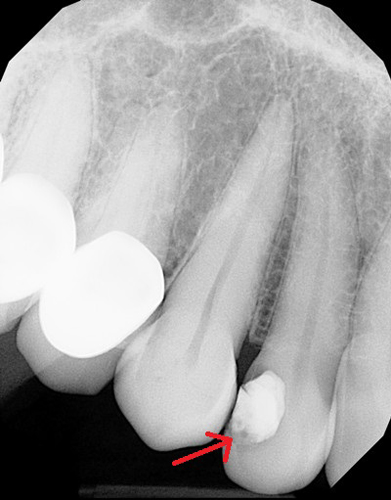
X-ray of an invisor tooth with a filling and a dark spot beneath it

Although there is a dark area near the fillng, the tooth doesn’t need root canal treatment, an extraction, or a dental implant

Thanks for sending us a copy of your x-ray. Maybe dental schools need to give more training in x-ray diagnostics. Although Dr. Brooksher would need to examine your tooth, your x-ray doesn’t show inflammation or any reason that a dentist would disturb it with root canal treatment. But what about the dark area beneath the filling?

Facts About a Dark Area Beneath a Filling

  1. Dark areas – Not all dark areas on a tooth x-ray are a result of tooth decay. Decay, a gap in the filling, or a radiolucent material beneath the filling will appear dark on the x-ray.
  2. Location of darkness – The dark area on your x-ray is on the surface of your tooth. In this case, your dentist can use an explorer and poke the area. If it’s soft, there is decay.
  3. Effect on tooth pulp – Tooth pulp includes the living tissue and nerves inside the tooth. Root canal treatment removes infected pulp. When the dark area on your x-ray isn’t near the pulp, you don’t need root canal treatment. On an x-ray, it might seem that the dark area is between the filling and tooth pulp. You can resolve the illusion while looking at the x-ray: Cover the white filling with your finger and look at the remaining tooth structure. You can see the dark area and the distance from the pulp.
  4. Comparison with adjacent tooth – The lamina dura is a thin white line around the tooth root. An infection will break the line around the root tip or pull it away from the tooth. Look at the x-ray on this page. The tooth with the filling, and the canine tooth next to it, has a lamina dura that intact. Both teeth are healthy. You won’t need root canal treatment. And you surely don’t need an extraction and dental implant.

If you still have reservations about the health of your tooth, consider scheduling an appointment for a second opinion. You can take your x-ray with you for a dentist to examine it in person.


Steven Brooksher, DDS practices in Baton Rouge, LA. Dr. Brooksher is one of ten dentists in Louisiana accredited by the American Academy of Cosmetic Dentistry.

Filed Under: Dental Implants Tagged With: Baton Rouge AACD dentist, baton rouge root canal, brightness on tooth xray, darkness on tooth x-ray, do i need root canal, extraction dental implant, lamina dura tooth, Louisiana AACD dentist, root canal dental implant

Three Reasons Your Dentist Recommends a Post and Core Even If Insurance Doesn’t Cover It

Posted on April 6, 2020 by AllSmiles.

I have a left incisor that is severely decayed. My dentist recommends a crown instead of a filling, but he wants to add a post and core. The dentist’s office submitted it to my insurance in early March. My insurance will give some benefits for the crown but not the post and core, which costs $420. So now, I’ll be paying for the remaining cost of the crown and the post and core. I’ll have to charge the balance on my credit card, which I am not fond of doing. Are the post and core necessary? Thanks – Russell

Russel –

Although your dentist is interested in your long-term oral health, your dental insurance company’s goal is to economize and save money. Your dentist might have explained the purpose of a post and core, but we’ll review it to help you understand your dentist’s perspective.

Why Are a Post and Core Needed?

Post and crown (top photo) and dental bonding built up around the post (lower photo)

A post and core give a strengthen your tooth and help anchor a dental crown

A dentist might place a post and core after root canal treatment. If there isn’t a lot of healthy tooth structure left, your dentist can’t properly prepare the tooth, and the crown can come off easily. The following steps are involved:

  1. Perform root canal treatment and remove decay and tooth pulp
  2. Insert a post into the canal of the tooth
  3. Bond the post in place
  4. Use dental bonding and shape it around the post to mimic the shape of a natural tooth prepared for a crown
  5. Bond the crown to the built-up post

The post and core are essential for reinforcing the tooth and creating a firm bond for a dental crown that lasts.

What Might Happen without the Post and Core?

  1. If a dentist bonds a crown to your severely decayed tooth, the tooth can further weaken and break. If the break is severe—or if the tooth gets infected—you might lose the tooth.
  2. And your dentist will need to replace it with a dental implant and crown—which is more costly than a post and core. A single implant costs over $1500. And there are additional fees associated with implant placement, including surgery, sedation, the implant crown, and more.
  3. Your dentist is protecting your oral health and limiting your long-term out-of-pocket expenses by recommending the post and core. Listen to your dentist—not the dental insurance company.

This post is sponsored by Steven Brooksher, DDS, a Baton Rouge dentist and a fellow of the International Congress of Oral Implantologists.

Filed Under: Dental Implants Tagged With: crown post and core, dental implant, dental insurance crown, dental insurance post and core, how much does a dental implant cost, implant crown, what fees come with a dental implant, what is a post and core, why do i need a post and core

He Ordered a Partial Denture Directly from a Lab and Wants a Refund

Posted on March 5, 2020 by AllSmiles.

About 7 years ago, I got a partial denture from my dentist that was excellent in quality. I know what lab he ordered it from, so this time I decided to order it myself directly from the lab. I requested the partial in January, and since that time, I’ve had so many complications. I’m beginning to wish that I just replaced my tooth with a dental implant. I was trying to save time and money. The partial denture replaces a front tooth, but it’s is loose and won’t stay fastened to the tooth to the left of the missing one. I can feel the partial rocking. I think there is too much plastic backing on it.

Of course, I returned to the lab to get it corrected. A lab tech ground down a tooth to try to improve my bite, but the clasp on the partial is on that same tooth, which is too small to hold the clasp. The denture plate is too short, and it is irritating the area where my tooth is missing. I’ve returned to the lab five times for this issue. During the last visit, the office manager told me that they would give me a 15% refund if I agreed not to return. I’m ashamed to see my dentist about this issue. I don’t want a 15% refund. I want all my money back. What are my options? – Thanks. Lennox from GA

Lennox,

We understand why you want a refund. But we don’t fully understand your description of the problems you’re having with your bite and discomfort from the plate of the partial denture. Dr. Brooksher would need to examine your partial denture to determine everything that’s causing your discomfort. But there are some issues we will address.

When a Partial Denture Rocks

What causes instability and rocking in a partial denture?

  • The rocking you describe results from a distorted framework in the partial denture.
  • If a dentist or lab tech doesn’t take impressions of your teeth and mouth correctly, the framework, which uses those impressions as a model, won’t fit.
  • A dentist—not a lab tech—has the experience and training to take accurate impressions that replicate your teeth and oral anatomy. Impressions from your dentist help the lab tech make a precise framework for your partial denture. Lab techs are not trained to take impressions, and it’s illegal for them to do so.
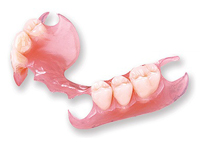
Picture of a partial denture witha plastic base and clasps

Partial denture with plastic clasps

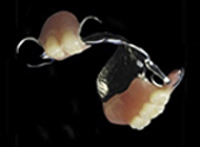
Diagram of a partial denture with a metal clasp

Partial denture with metal clasps

How to Get Your Money Back from a Poor-Fitting Partial Denture

The lab tech should not have taken the dental impressions for your partial denture. The solution?

Threaten to report the tech to the state dental board. It may seem unfair to report the lab tech to the dental board because you asked him to make a partial denture and bypassed your dentist. But the technician knew what you didn’t: It is illegal for technicians to take impressions of your teeth and mouth. In addition to threatening to report the incident to the state dental board, you can tell the tech that you’ll volunteer to be a witness for the prosecuting attorney. Likely, the lab will readily give you a full refund.

We hope this is a teaching moment for all patients who are tempted to bypass their dentist and order dental restorations directly from a lab.

What About a Dental Implant?

Diagram of the phases of a dental implant for a comparison to a partial denture.

A dental implant is embedded in your jawbone to replace a missing tooth

If you’re undecided about whether to get another partial denture or a dental implant, no other form of tooth replacement is more effective than an implant. Unlike a partial denture, a dental implant has features that make it look and feel natural:

  • It’s a titanium screw that an oral surgeon or implant dentist will embed in your jawbone like a tooth root.
  • Implants fuse with your jawbone to anchor the replacement tooth.
  • An implant stands alone. There are no clasps that put pressure on adjacent teeth.
  • Your implant dentist will attach a dental crown to the top of the implant. It replaces the part of your tooth above the gumline.

But your outcome with a dental implant depends on the skill of the dentist who places it and restores it with a dental crown. Look for an experienced, highly skilled implant dentist. Don’t bypass any aspects of treatment or take shortcuts this time. Dental implant mistakes can be disastrous, and you’ll have to start the entire process again.


This post is sponsored by Steven Brooksher, DDS, a Baton Rouge dentist and a fellow of the International Congress of Oral Implantologists.

Filed Under: Dental Implants Tagged With: front tooth dental implants, loose partial denture, missing front tooth, order directly from dental lab, partial denture clasps, partial denture front tooth, partial denture hurts, partial denture vs dental implant, refund for partial denture, refund from dental lab

  • « Previous Page
  • 1
  • 2
  • 3
  • 4
  • 5
  • Next Page »
Dr. Steven Brooksher, DDS., LLC
Meet
Dr. Brooksher

Dr. Brooksher is a past winner in the International Smile Gallery competition of the American Academy of Cosmetic Dentistry.

Meet Dr. Brooksher
Dr. Brooksher Smile Gallery
Gallery
of Smiles

Can you imagine yourself with one of these beautiful new smiles?

See the Gallery

Reviews

Slide 1

“I have horrible anxiety at dental offices. I have never been as comfortable as I am at Dr. Brooksher’s office. Everyone is really nice, accommodating, and understanding!”

Jay Alex

Slide 1 - copy

“Dr. Brooksher is humble, kind, funny, and easy to get along with. His staff is friendly, too! I have the utmost respect for his work. I've never been this comfortable going to the dentist.”

Christopher Jeffers

Slide 1 - copy - copy

“Dr. Brooksher came highly recommended by so many of my present and former coworkers. I've had fear of the dentist all my life and finally got the courage to go. I can now say for myself that he is the best—hands down.”

Patricia Madison Anthony

Slide 1 - copy - copy - copy

“Sometimes I feel that Dr. Brooksher and his staff care more about my teeth than I do. They are professional and prompt, so definitely be on time for your appointment!”

Brock George

Slide 1 - copy - copy - copy - copy

“I’ve been a patient at Dentistry by Brooksher for more than 15 years. They are always thorough and professional. Dr. Brooksher explains your options and the best treatment plans. He and his staff are a pleasure to deal with.”

Wilson Alvarez

contact
Map Too Brooksher Dental Office
Steven H. Brooksher, DDS, AAACD, FICOI
1010 South Acadian Thruway
Ste A
Baton Rouge, LA 70806

OFFICE HOURS Mon - 8:00 am - 5:00 pm
Tuesday - 7:00 am - 3:00 pm
Wed - 8:00 am - 5:00 pm
Thurs - 7:00 am - 3:00 pm

PHONE (225) 346-8625

Request an
Appointment
Dr. Steven Brooksher, DDS.
Address: Steven H. Brooksher, D.D.S., LLC
1010 South Acadian Thruway, Ste A
Baton Rouge, LA 70806
Phone: (225) 346-8625
Pay Online
REVIEW ME:
Office Hours: Mon - 8:00 am - 5:00 pm
Tuesday - 7:00 am - 3:00 pm
Wed - 8:00 am - 5:00 pm
Thurs - 7:00 am - 3:00 pm
  • Best Dentist in Baton Rouge
  • Blog
  • Baton Rouge Lumineers
  • Privacy Policy

©2015-2026 Steven H. Brooksher, D.D.S., LLC | Doing Business As: Dentistry By Brooksher • All rights reserved •

Website Design and SEO by Infinity Dental WebIDW logo

Mobile Menu Icon Dr. Steven Brooksher, DDS.
  • Home
  • About Us
    • Meet Dr. Brooksher
    • Meet Our Team
    • Your First Visit
    • Contact Us
    • What Makes Us Different?
    • Patient Forms
    • Financial Policies
    • Pay Online
    • Request an Appointment
  • Cosmetic Dentistry
    • Cosmetic Dentistry
    • Smile Gallery
    • Porcelain Veneers
    • Dental Bonding
    • Teeth Whitening
    • Smile Makeover
    • SmileFy Smile Design
    • Porcelain Crowns
  • Tooth Replacement
    • Dental Implants
    • Dental Implant Hybrids
    • Implant Overdentures
    • Dentures
  • Sedation
  • Other
    • Emergency Dentist
    • Metal-Free Dentist
    • Porcelain Crowns
    • TMJ Treatment